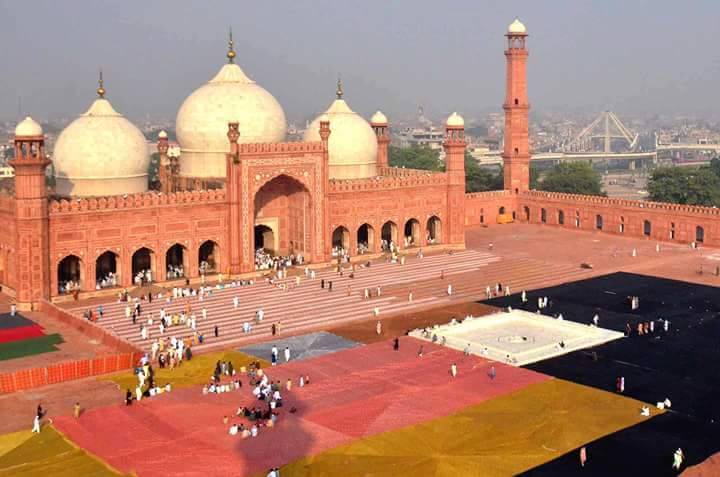
Badshahi Mosque (constructed 1672-74)
Badshahi mosque is one of the few substantial architectural monuments constructed for the duration of Emperor Aurangzeb's lengthy rule from 1658 to 1707. It is currently the 5th biggest mosque withinside the global and became no doubt the most important mosque withinside the global from 1673 to 1986 whilst the Faisal Mosque became built in Islamabad. Although it became constructed past due withinside the Mughal technology in a duration of relative decline, its beauty, elegance, and scale epitomize Mughal cultural success like no different monument in Lahore.
Construction of the mosque started out in 1671 below the route of Muzaffar Hussain (Fida'i Khan Koka), Aurangzeb's brother-in-regulation and the governor of Lahore. It became at first deliberate as a reliquary to shield a strand of the Prophet's hair. Its grand scale is prompted with the aid of using the Jama Mosque of Delhi which have been constructed with the aid of using Aurangzeb's father Shah Jahan. The plan of Badshahi mosque is largely a rectangular measuring one hundred seventy meters on every side. Since the north stop of the mosque became constructed alongside the brink of the Ravi river, it became now no longer viable to put in a north gate just like the one used withinside the Jama Mosque, and a south gate became additionally now no longer built so one can keep the general symmetry. Within the courtyard, the prayer corridor capabilities 4 minarets that echo in minature the 4 minarets at every nook of the mosque's perimeter.
The prominence of the mosque withinside the imperial imaginative and prescient became such that it became built only a few hundred meters to the west of Lahore Fort. A unique gate dealing with the mosque became introduced to the citadelress and special the Alamgiri gate. The area in between--the destiny Hazuri Bagh garden--became used as a parade floor wherein Aurangzeb could evaluate his troops and courtiers. The Hazuri Bagh seems to be at a decrease degree than the mosque because the latter became constructed on a six meter plinth to assist save you flooding.
The mosque did now no longer fare nicely for the duration of the guideline of thumb of Ranjit Singh, the Maharaja of the Sikh Empire. When Ranjit Singh took manipulate of Lahore in 1799 the mosque's courtyard became used as a solid and the hujras (cells) across the perimeter have been occupied with the aid of using his soldiers. Ranjit Singh himself used the adjoining Hazuri Bagh as his legit royal court. When William Moorcroft of England visited Lahore in 1820, he recorded that the mosque as getting used as an workout floor for the Sipahi infantry. Twenty years later, a slight earthquake struck lahore and collapsed the sensitive marble turrets on the tops of every minaret. The open turrets have been used as gun emplacements a yr later whilst Ranjit Singh's son, Sher Singh, occupied the mosque to bombard Lahore Fort for the duration of the Sikh civil war.
After the British took manipulate of Lahore in 1846 they persisted to apply Badshahi Mosque as a navy garrison. It became now no longer till 1852 that the British set up the Badshahi Mosque Authority to supervise the recovery of the mosque in order that it can be again to Muslims as an area of worship. Although upkeep have been carried out, it became now no longer till 1939 that widespread upkeep started out below the oversight of architect Nawab Zen Yar Jang Bahadur. The upkeep persisted till 1960 and have been finished at a price of 4.eight million rupees.
Plan view
Image drawn with the aid of using Timothy M Ciccone following plan in "Architecture in Pakistan" with the aid of using Kamil Khan Mumtaz.
Location
Bibliography
Khan, Ahmad Nabi. Islamic Architecture of Pakistan: An Analytical Exposition.
Islamabad: National Hijra Council, 1990.
Koch, Ebba. Mughal Architecture
New Delhi: Oxford University Press, 2002.
Michell, George (editor). Architecture of the Islamic World: Its records and Social Meaning
London: Thames and Hudson, 1978.
Muhammad Wali Ulla Khan. Lahore and its Important Monuments
Karachi: Anjuman Press, 1973.
Mumtaz, Kamil Khan. Architecture in Pakistan.
Singapore: Concept Media Pte Ltd, 1985.
Rajput, A. B. Architecture in Pakistan
Karachi: Pakistan Publications, 1963


0 Comments